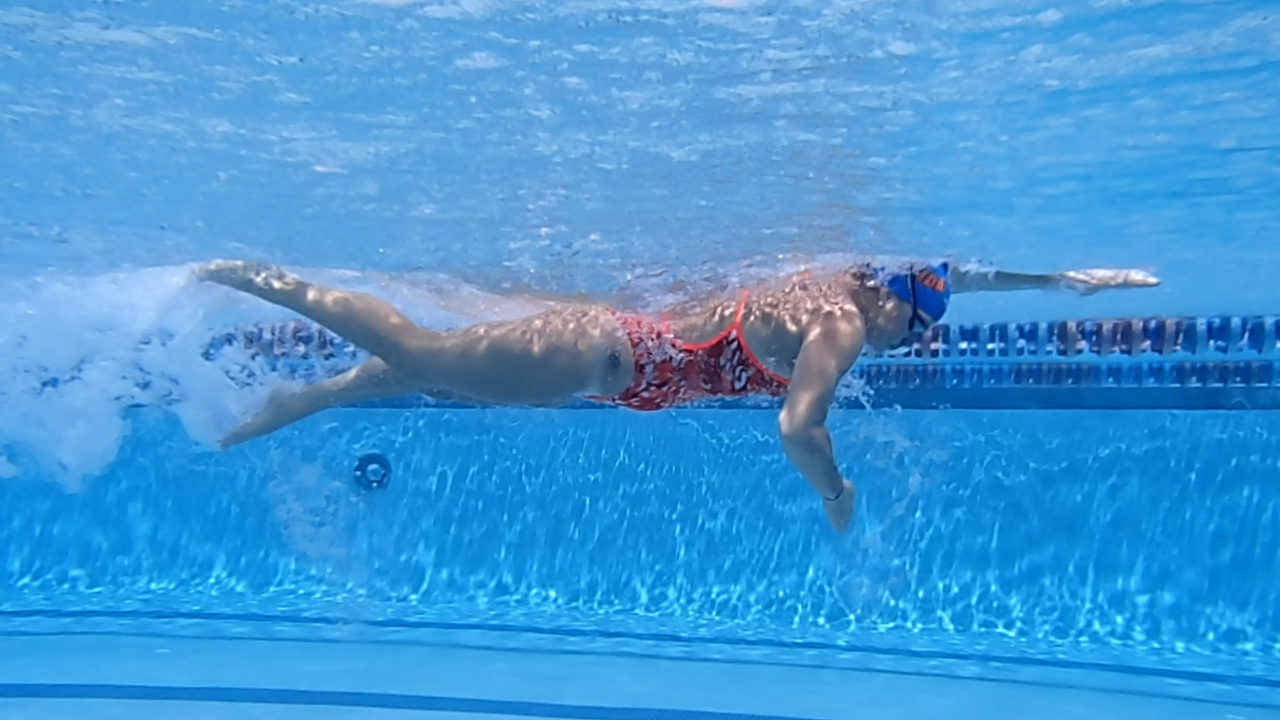
In this post we’re going to dig into the topic that inspired me to write the Swim Speed series of books – the underwater pull path and the debate that surrounds it.
Before we start though, I should clarify that the pull path is not really being debated. Rather, the topic seems to sit upon a pendulum and is swung with great weight one direction, then the other, and up to this point in swimming history, back to it’s original position. Coaches don’t as much debate it as they seem to accept whichever side the pendulum swings at a given period of time.
So, currently, in 2026, my guess is that if you’ve been on a pool deck at any point the past 20-25 years and engaged in conversation about swim technique with a coach or another swimmer, then you’ve heard that when you pull underwater you should “pull straight back.”
This instruction is communicated very purposefully, because it is meant to erase any acknowledgement of the instruction that preceded it – that swimmers should pull in an S-shaped pattern underneath their bodies. The S-pull is considered old-school now.
However, the funny thing about the S-pull era was that it replaced the era that preceded it – which was a “pull straight back” era.
Here’s a recap:
1960s and before: Pull straight back era
1970s to 1990’s: S-pull era
2000’s – present: Pull straight back era
So, in 2026 we’re in an era where “S” is a 4-letter word on pool decks all over the world.
This post doesn’t go into the science and reasoning behind the two opposing pull path theories, because that would take too many pages; however, I do go into the history and explanations in Swim Speed Secrets 2nd ed and Swim Speed Strokes if you’re interested.
My hope in this short post is to bring the topic to the surface so the coaching community comes to an agreement on how to describe and teach the intricacies that are seen in the elite underwater pull path.
The truth is that an elite swimmer’s pull path is neither straight back nor a notable S shape.
It has elements of both, and this fact has always been acknowledged by those who study swim mechanics. The reason coaching instruction has swung from “straight back” to “S” then to straight back again is due to the science at the time and which stroking motion (straight back or S-shaped) the science shows is more propulsive and more prominent.
Pause here for a moment and take note of the words “more propulsive and more prominent.” These words tell us that the elite underwater stroking path has elements of both a back-pressing motion and a curve/change of direction, and that one is simply more dominant than the other.
For the past 20-25 years science has told us that the back-pressing element of the path is more propulsive and most prominent. At Swim Speed Coach we agree with this science, especially since the thousands of photos of elite swimmers we’ve taken show they predominantly press back. However, somehow when the science was translated into coaching instruction, the curvilinear motion seen in the stroke was disregarded completely. Swim instruction was watered down to just 3 words, “pull straight back.” The phrase “train tracks” also gained popularity and is used synonymously with “pull straight back.”
The curve got left out of coaching instruction simply because it is not the dominant motion, but this curve, however slight it may be, is critical. It is important not just for propulsive power, but also for shoulder health.
I would like to encourage all coaches, swim organizations and federations to stop using “pull straight back” and “train tracks” terminology. Some will defend the use of these descriptions, saying they use those words because they believe swimmers will naturally and intuitively incorporate a curved path into their underwater stroke. They feel that the instruction to pull straight back keeps swimmers from putting too much of a curve into the stroke.
I understand that logic, but here’s a word of warning: The most conscientious swimmers take this instruction literally and do indeed pull 100% straight back. The result: decreased propulsion, an inability to feel how the other components of the stroke connect with the pull, and worse, almost guaranteed shoulder injury.
Below is a comparison of the pull path of two swimmers. One is Townley Hass, an Olympic freestyler, incorporating a slight diagonal change of direction to his predominantly back-pressing pull path. The other series is a swimmer who applies the instruction “pull straight back” literally.
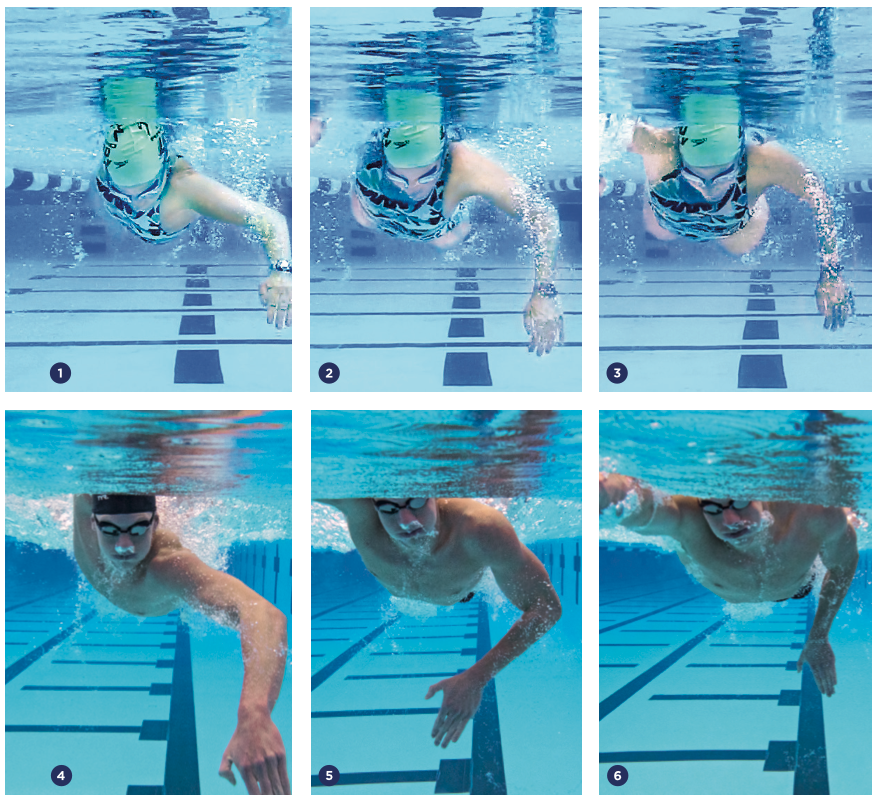
The underwater pull path is intricate and involves a unique rotation of the upper arm that is teachable and doable. So let’s “up the art of coaching” and come to an agreement on the best way to accurately describe the underwater pull so all swimmers can reach their potential.
Sincerely,
Sheila Taormina
SWIM SPEED STROKES: showcases 100’s of photos of the fastest swimmers in the world stroking with a back-pressing curvilinear path in all four competitive strokes.
SWIM SPEED SECRETS 2nd EDITION: showcases 100’s of photos of Olympic swimmers and the back-pressing curvilinear path in freestyle. The path is also observed with the patented STGRID.